
Cullman Criminal Records Do Not Merge
A Cullman County arrest can create several related records without creating one complete public file. The arresting officer writes an incident or arrest report. The Cullman County Detention Center creates a booking entry and captures fingerprints and a photograph. If a prosecutor proceeds, the Circuit Clerk opens a court file that tracks the filed charge, hearings, orders, disposition, and sentence. ALEA may later connect the fingerprint arrest cycle to the reported court result.
Each source answers a different question. A police report describes the event from the agency's view. A booking record proves that jail intake occurred, not that guilt was established. A court docket shows what was filed and how the charge moved. A personal ALEA criminal history review shows fingerprint-linked Alabama repository data. Delays and missing links can occur, so a careful Cullman County criminal record check compares the source record with the final court outcome.
| Record | Cullman County custodian | Best use |
|---|---|---|
| Incident or arrest report | CCSO or the city police agency | Event narrative and initial allegation |
| Booking record | Cullman County Detention Center | Intake, bond, hold, and custody facts |
| Criminal case file | Circuit Clerk or municipal clerk | Filed charge, docket, disposition, and sentence |
| Alabama CHRI | ALEA Criminal Records Identification Unit | Personal fingerprint-linked statewide review |
The official Cullman County overview shows the local government setting for these separate offices.

That county source is a starting point for public offices, while criminal records remain with the agency or court that maintains them.
Checking Criminal History in Cullman County
Begin by defining the record slice. Current county custody calls for the jail. A source report belongs with the arresting agency. Filed felony and misdemeanor matters belong with the Circuit Clerk, while city ordinance and municipal traffic matters may stay in a municipal court. A personal statewide criminal history requires ALEA's fingerprint process. This order keeps a narrow Cullman County search from being mistaken for a complete Alabama history.
- Identify the event, likely agency, name spelling, date range, and any report, citation, or case number.
- Ask the arresting agency for its report, or call the detention center when present custody is the issue.
- Search Cullman County trial cases through Just One Look, then use the Circuit Clerk for older, missing, or certified material.
- Check the correct municipal court when a city citation, ordinance case, or city warrant may be involved.
- Use the fingerprint-based ALEA application to review and, when needed, challenge your own statewide history.
A spelling variant can split search results, and two people can share a name. Match a result with a case number, date of birth when lawfully shown, court, and charge. If a dismissal is absent from ALEA data, obtain the official disposition from the clerk and use ALEA's challenge route rather than assuming every database will correct itself.
Note: A county court search does not exhaust Cullman, Arab, or Hanceville municipal records.
Cullman County Sheriff Record Channels
The Cullman County Sheriff's Office places its Records Division within Administration. The unit inputs warrants and civil-process papers, and it manages and releases reports generated by CCSO. The official site does not publish a dedicated online report request form, fee schedule, clearance-letter product, or public warrant database. Call the Sheriff's main line at 256-734-0342 or ask at 1910 Beech Avenue SE, Cullman, before relying on an unofficial listing.
The Cullman County Sheriff's official homepage supplies the agency's current routes and office context.
The agency page confirms that CCSO records, detention information, and court records should not be treated as one search product.
The Sheriff's current officeholder page identifies Matt Gentry as the listed sheriff.
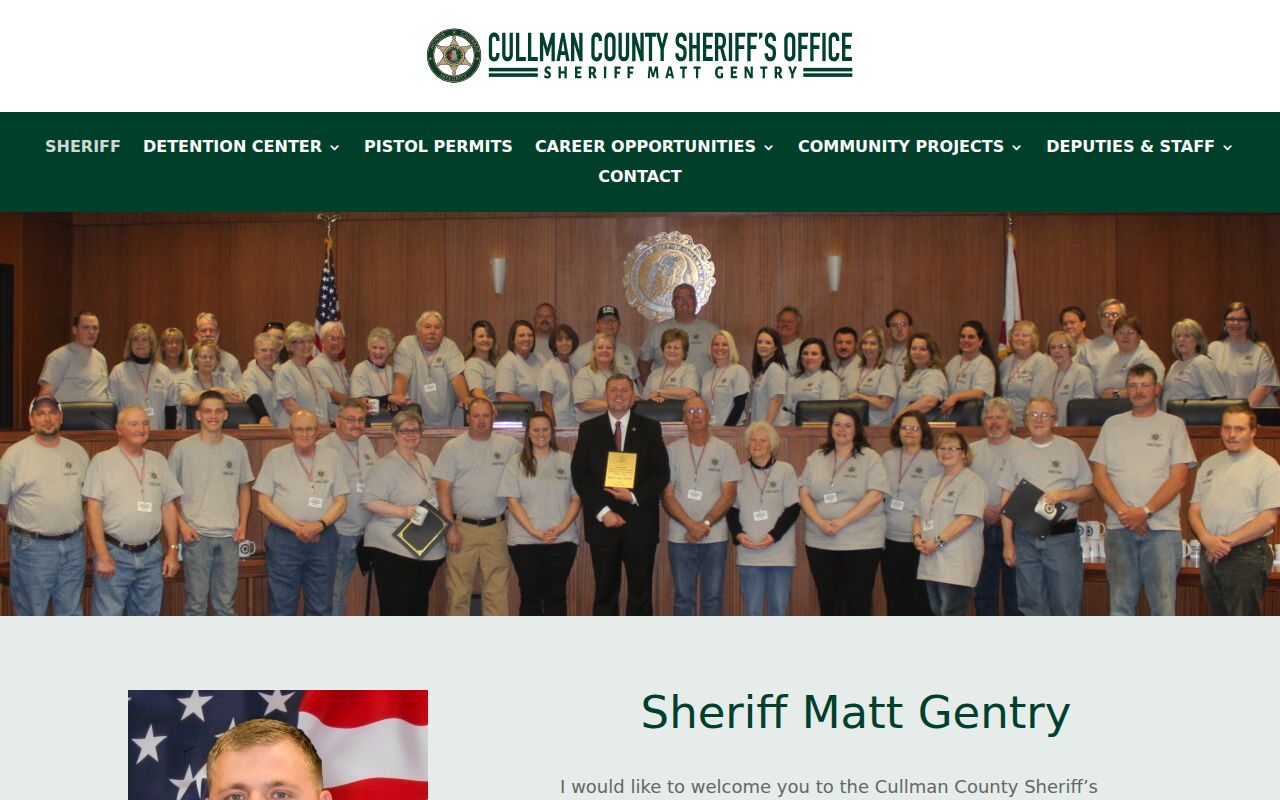
Officeholder information matters for attribution, but a records request should still go to the Records Division rather than to an individual official.
Alabama Official Background Checks
ALEA's general-public route is a review of one's own Alabama criminal history, not an unrestricted public name search. The applicant submits the Application to Review Alabama Criminal History Record Information, a classifiable fingerprint card or approved AFIS printout, current photo identification, and a $25 cashier's check or money order. Each extra copy costs $5. An authorized law-enforcement agency can capture the fingerprints, but local availability and capture fees must be confirmed with that agency. A personal federal counterpart is the FBI's Identity History Summary process, which is not a Cullman County case search.
The ALEA personal criminal-history page describes the restricted Alabama Background Check system and the public self-review alternative.
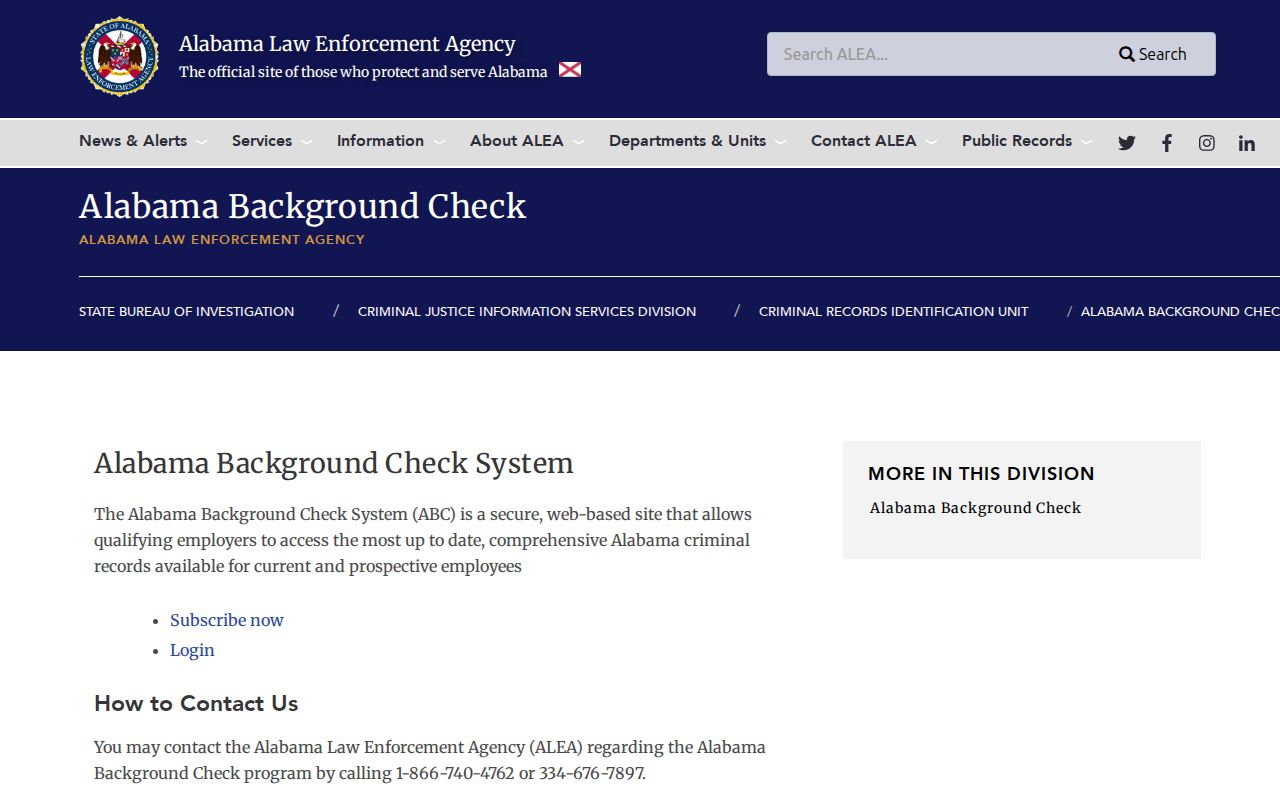
This official channel is the right place to verify fingerprint-linked repository data and start a challenge when an arrest or disposition appears wrong.
| Official item | Published amount |
|---|---|
| Initial ALEA personal CHRI review | $25 |
| Each additional copy | $5 |
| Local fingerprint capture | Confirm with the capturing agency |
Criminal Record Types
Cullman County criminal records reflect distinct stages of the justice process. Their labels matter because an arrest allegation can change when a prosecutor files a complaint or an indictment, and a filed charge can later end in dismissal, acquittal, or conviction. Custody and supervision sources also cover different populations.
- Police report: the originating agency's narrative, probable-cause facts, initial charge, and protected witness or victim segments.
- Booking entry: detention intake, fingerprints, photograph, bond or hold, and current or release status.
- Court file: filed charges, motions, hearings, orders, costs, judgment, sentence, and available document images.
- Warrant record: a court-issued arrest, bench, or search command whose public status can be limited or delayed.
- Custody or supervision record: county jail, ADOC, Community Corrections, probation, and parole entries that cover separate stages.
- Registry listing: statutorily public information sent by local law enforcement to ALEA.
The ALEA Criminal Records Identification Unit explains the state repository role.
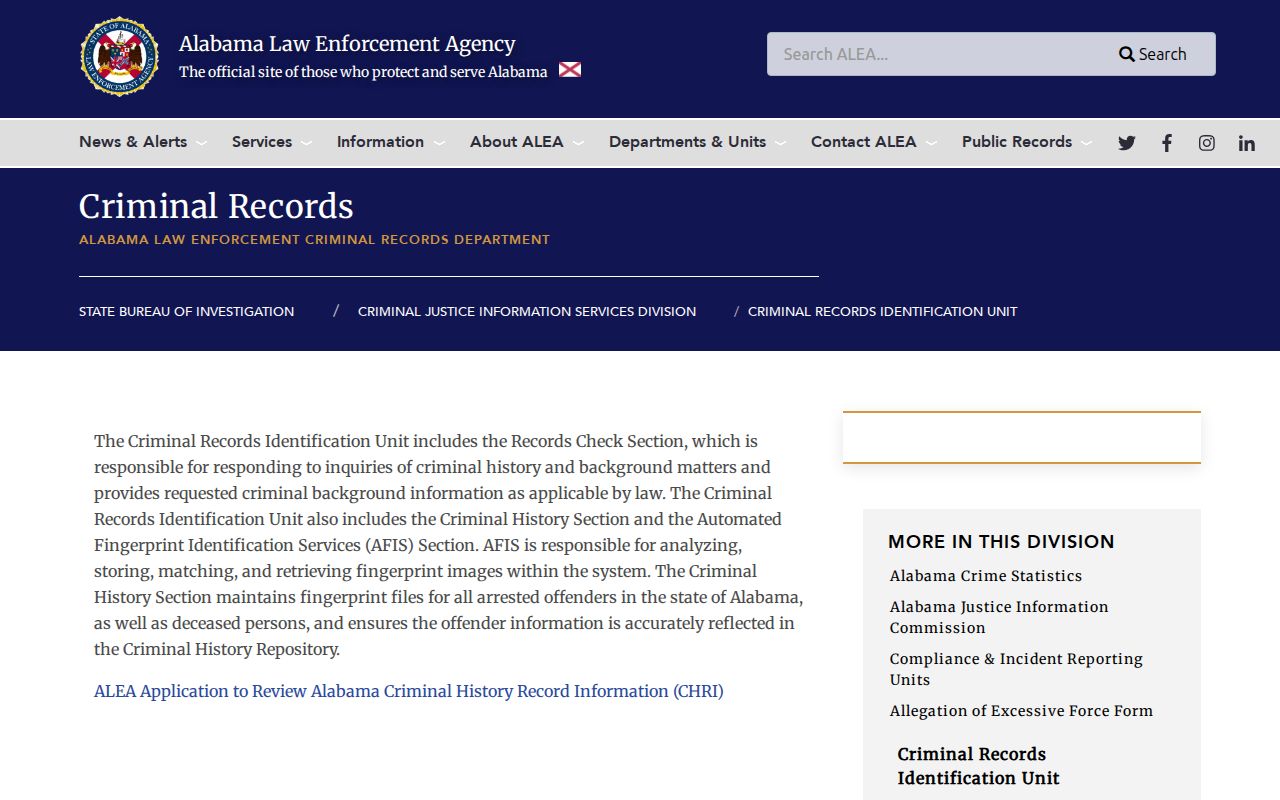
ALEA repository information is related to local reports and court files, but it does not replace those source records.
Cullman County Has No Jail Roster
No current public booking roster was located on the official Cullman County Sheriff's site. That absence should lead to official fallback channels, not a private mugshot database. Call the Cullman County Detention Center at 256-735-2400 for present custody. Ask Sheriff Records for a historical CCSO booking or report. Check the court file after a charge has been filed. Use ADOC Inmate Search only for sentenced state prisoners, not ordinary county detainees, and use the federal locator only for federal custody.
The detention center at 1900 Beech Avenue SE is described as a 553-bed facility serving every municipality in Cullman County. Its staff receives and processes people, captures prints and photos, and maintains booking records. Inmate Sales provides calls, messages, and on-site or remote visits. Its app is for communication and visits, not inmate lookup.
Custody check: A released status does not erase the historical booking or answer how the court case ended. Confirm the report and docket separately.
For the official sequence from arrest to filed charge, use the county's Cullman County arrest lookup routes and the clerk channels together.
Inside a Cullman County Criminal Record
A criminal record's fields depend on its creator. Repository records group identity and aliases with fingerprint identifiers, arrest cycles, arresting agencies, charges, court references, reported dispositions, sentences, and custody or supervision links. Court files add pleadings, event dates, judge and attorney information, bond, costs, rulings, and document images. Booking records focus on intake and present custody. Public versions remove protected identifiers and may omit juvenile, youthful-offender, sealed, or expunged material.
| Name and identifiers | Legal name, aliases, date of birth where authorized, and agency or case identifiers. |
|---|---|
| Arrest and booking | Agency, date, intake, initial allegations, bond or hold, and custody status. |
| Filed charge | Complaint, indictment, citation, statute, and charge-level court tracking. |
| Disposition | Dismissal, nolle prosequi, acquittal, plea, verdict, or another entered result. |
| Sentence | Custody term, probation, restitution, costs, or other court-ordered terms. |
| Restrictions | Redactions or withheld juvenile, victim, sealed, and expunged information. |
- Disposition
- The current or final outcome entered for a charge.
- Nolle prosequi
- A prosecutor's decision to end a charge without a conviction.
- Capias
- A court order directing that a person be taken into custody.
- Expungement
- Alabama's statutory process for isolating eligible arrest and case records.
Cullman County Warrant Record Routes
CCSO Records inputs warrants, but the Sheriff offers no public warrant-search form. A person checking their own possible warrant should call the Sheriff's main line and then contact the issuing court. Circuit and District warrants route through the Circuit Clerk's divisions. A municipal failure-to-appear warrant belongs with the relevant municipal court. Just One Look may show a warrant or capias event in a paid case detail, but it is not a complete live warrant list.
Cullman's published misdemeanor process starts with a Sheriff or police incident report. Warrant applications are handled Tuesday and Thursday from 8:00 to 11:30 a.m. If issued, the warrant goes to the Sheriff for service, and an arrest leads to a first-appearance docket. Status can change after service, recall, bond, or compliance, so ask the issuing clerk for current instructions rather than appearing based on stale third-party data.
Note: Secret Witness accepts crime information but is not a warrant-status service or an emergency line.
Public Access Laws in Alabama
The Alabama Open Records Act gives Alabama residents a right to inspect and copy public writings, subject to specific exceptions. It does not put every criminal record online or remove confidentiality rules. The office holding the item may redact protected victim or minor information, withhold active-investigation material, or restrict juvenile, youthful-offender, sealed-warrant, and expunged records. A focused request that names the record, agency, date range, and known identifier is more useful than a demand for every file tied to a name.
Key Alabama authorities:
Ala. Code § 36-12-40 establishes resident access to public writings, subject to lawful exceptions.
Ala. Code § 41-9-601 penalizes false-pretense acquisition or unauthorized communication of criminal-offender information.
Ala. Code § 15-27-1 begins Alabama's principal nonconviction expungement rules.
Ala. Code § 15-20A-8 defines public sex-offender registry information and limits misuse.
Public access is a right to qualifying records, not a guarantee that all identifiers or every stage will be visible in one Cullman County criminal history search.
Cullman County Commission Record Requests
Since October 1, 2024, an Alabama resident seeking Commission-controlled records must use the county's standard request form and procedure, show reasonable proof of Alabama residency, and file in person in Commission Room 105 at the Cullman County Courthouse. This route does not replace requests to the independently elected Sheriff or to the courts. The form asks for each record in detail, the preferred response and format, contact data, residency certification, and proof attachment.
The Cullman County Commission page provides the current request route and office information.

The county classifies requests by workload, estimates administrative fees, and can require prepayment when more than eight staff hours are projected.
Standard requests are generally acknowledged within two business days and substantively answered within 15 business days. Time-intensive requests share the two-day acknowledgment target but may receive a substantive response within 45 business days, with extensions when needed. The Public Officer can be reached at 256-775-4878. Payment options listed in the procedure are cash, money order, or certified bank funds.
Sealed, Expunged, and Restricted Records
Alabama uses the term expungement. Eligibility depends on the charge, outcome, offense category, waiting period, and current version of Chapter 27 of Title 15. Some nonconviction matters and limited conviction categories can qualify, while violent offenses, sex offenses, serious traffic matters, and other listed exclusions require close review. A search-result label alone cannot establish eligibility.
A Cullman County petition is filed through the Circuit Clerk in Room 303. It must identify the charge, arresting agency, court and case identifiers, disposition, and agencies holding the records. The generally stated statutory administrative amount is $500 plus ordinary civil filing costs, subject to exceptions and indigency rules. Confirm the current total and required certified records with the clerk before filing.
An order does not mean every legally authorized system instantly deletes every trace. The clerk routes the order to ALEA and named agencies. Private cached copies may require separate correction requests. A sound follow-up checks the public Cullman County docket and reviews personal ALEA CHRI. Juvenile and youthful-offender records use separate confidentiality rules.
Cullman County Supervision Records Differ
Adult probation and parole are state-run through the Alabama Bureau of Pardons and Paroles. The Cullman Field Office is in Courthouse Room 30 at 500 2nd Avenue SW, with phone 256-775-4771. It serves Cullman County from 8:00 a.m. to 4:15 p.m. on weekdays and closes from noon to 1:00. There is no official public probationer name search. Verify a probation sentence or revocation event through the sentencing court file, then ask the field office what it may lawfully confirm.
The official Cullman probation and parole field-office page supplies its current contact details.
This state supervision office is distinct from Cullman County Community Corrections, a court-ordered local sentencing or diversion channel in Courthouse Room 211.
The District Attorney's office also shapes the filed case record. The Cullman County District Attorney site identifies the 32nd Judicial Circuit prosecution office.
Police allegations may change when that office files, amends, or ends charges, which is why the court disposition should be read with the arrest record.
Cullman County Criminal Records by City
City records add another layer. Cullman Police keeps its own reports and Cullman Municipal Court offers a ticket search. Arab crosses the Cullman and Marshall county line, so event location controls which county court and sheriff may hold the next stage. Hanceville's current official directory does not list a police department, and the 2025 evidence crisis makes present and legacy custody a point to confirm with City Hall and CCSO. The three largest incorporated cities by the Census Vintage 2025 ranking are Cullman, Arab, and Hanceville.
Cullman Criminal Records
Population estimate 20,799. City police reports and a municipal ticket portal start the local search.
Arab Criminal Records
Population estimate 9,061. Confirm the event's county before choosing the next court.
Hanceville Criminal Records
Population estimate 3,390. Confirm the current custodian for police and evidence records.
Cullman Criminal Record Counts Need Dates
Cullman County's July 2025 population estimate was 94,009, up from 87,866 counted in 2020. The county spans a broad rural area, the Interstate 65 corridor, municipalities, campus police territory, Sheriff jurisdiction, and state-trooper activity. That mix helps explain why a “Cullman arrest record” cannot be reduced to one agency database.
The latest readily extractable official county crime table in the research is ALEA's 2017 report. It lists 1,764 index crimes countywide, including 307 burglaries, 1,181 larcenies, and 172 vehicle thefts. Those numbers are historical counts, not present conditions or current case totals. They must not be mixed with a different year's population, a city-only table, or partial agency coverage.
The ALEA Crime in Alabama channel is the official source for that context.
Use dated statistics to understand scale, then use the clerk, law-enforcement agency, or repository to answer a record-specific question.