
Sex Offender Checks in Cullman County
The Alabama Law Enforcement Agency Criminal Justice Information Services division maintains the statewide public registry. Cullman County law enforcement registers covered people and supplies changes, photographs, and fingerprints to ALEA. ALEA says public data updates daily or in real time from local submissions. A suspected wrong address or failure to comply should be reported to local police or the Sheriff for verification.
The ALEA Sex Offender Registry FAQ explains statewide publication, local updates, and reasons an entry may not appear.
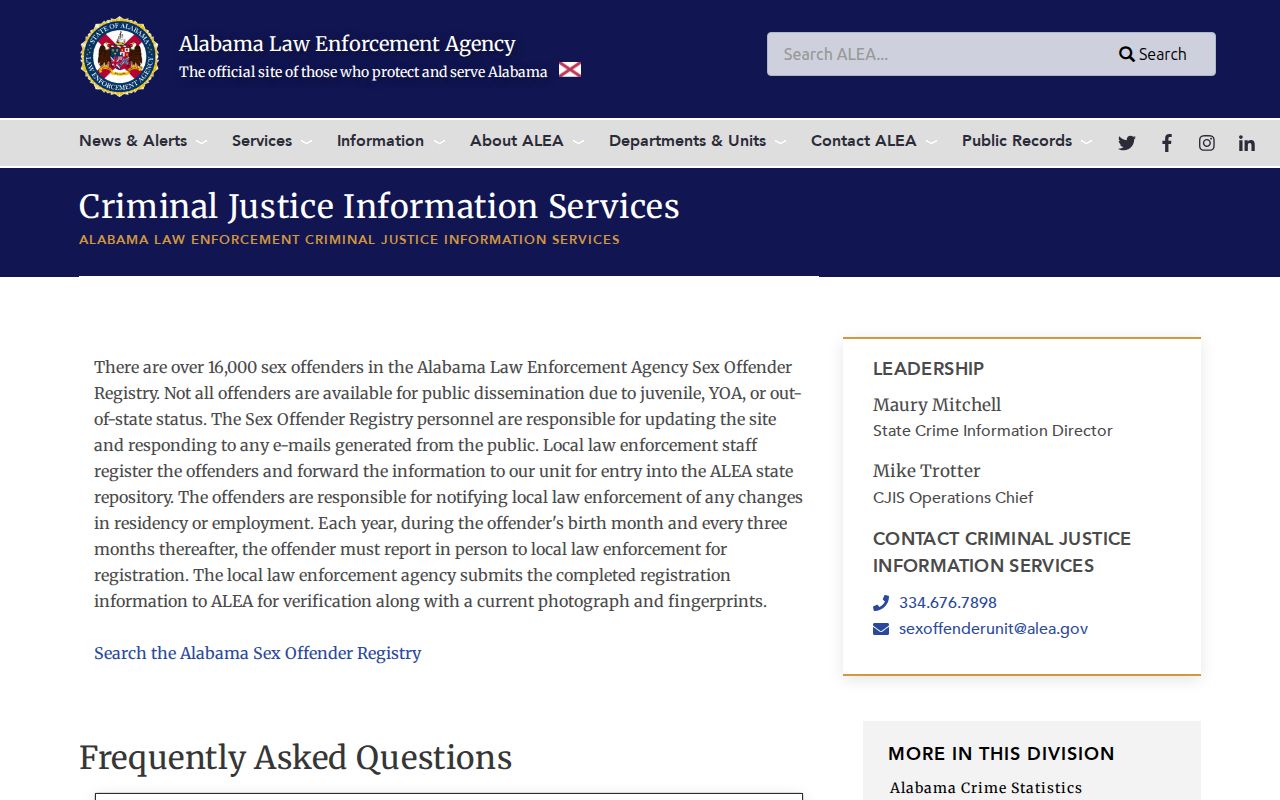
The official FAQ is the source for Alabama registry rules. It is not a separate Cullman County list.
Cullman Registry Updates Start Locally
ALEA can publish only what local agencies transmit. Address changes, new photographs, verification activity, and compliance status begin with the registering office. If a Cullman County address looks stale, do not confront anyone there. Give the specific concern to the Cullman County Sheriff's Office or the police agency with jurisdiction so officers can verify and send a correction.
The ALEA Registry Unit handles system questions at 334-676-7898 or sexoffenderunit@alea.gov. This division of work explains why local verification can precede a statewide public update. It also explains why the registry should be read as an official reporting system, not a copy of every criminal conviction.
Local submission also matters when a listed person moves, changes a school or work address, acquires a covered vehicle, or receives a new compliance status. The registry map may reflect the last information delivered to ALEA while an agency is checking a reported change. Give officers the profile details and the specific address concern. Do not assume a delayed public update proves intentional noncompliance.
How to Search the Alabama Law Enforcement Agency Sex Offender Registry
The official ALEA link opens the OffenderWatch registry search interface. It is free and no login is stated. Automated inspection met a JavaScript and captcha gate, so exact radius values, sorting, export, and pagination were not verified. Alabama law does establish required search modes by name, city or town, county, ZIP, and geographic radius.
- Open the official registry link from ALEA and review its conditions of use.
- Search by name, or use address, city, ZIP, Cullman County, and radius controls.
- Compare the list or map result with the intended name or area.
- Open the profile and read its address, offense history, status, and other public fields.
| Field Label | Type | Required | Notes |
|---|---|---|---|
| Last Name; First Name | Text | Mode-dependent | Name-search validation was not accessible |
| Street Address | Text | Shown as required in address mode | Used for geographic search |
| City; State; ZIP | Text/dropdown | Mode-dependent | Alabama is the state default |
| County or jurisdiction | Selection | Mode-dependent | Choose Cullman County for a countywide filter |
| Radius and results | Dropdown/map-list | Mode-dependent | Exact radius values were not verified |
Address alerts are part of OffenderWatch, but precise statewide form fields and radii could not be confirmed behind the live gate. Verify the displayed options when signing up.
Name and place searches answer different questions. A name search helps when identity is known, while a city, county, ZIP, or radius search supports awareness around a place. Compare aliases, photograph, physical description, and addresses before drawing a conclusion from a similar name. Search results can change as local agencies send verified updates, so return to the official interface when current information matters.
Cullman and National Registry Searches
Use the Alabama registry for a detailed Cullman County sex offender search. Use the U.S. Department of Justice National Sex Offender Public Website when a name or address may cross state lines. NSOPW federates data from participating jurisdictions. It is not an independent conviction database and can return only the public data supplied by those jurisdictions.
The national registry interface provides a broader geographic layer.
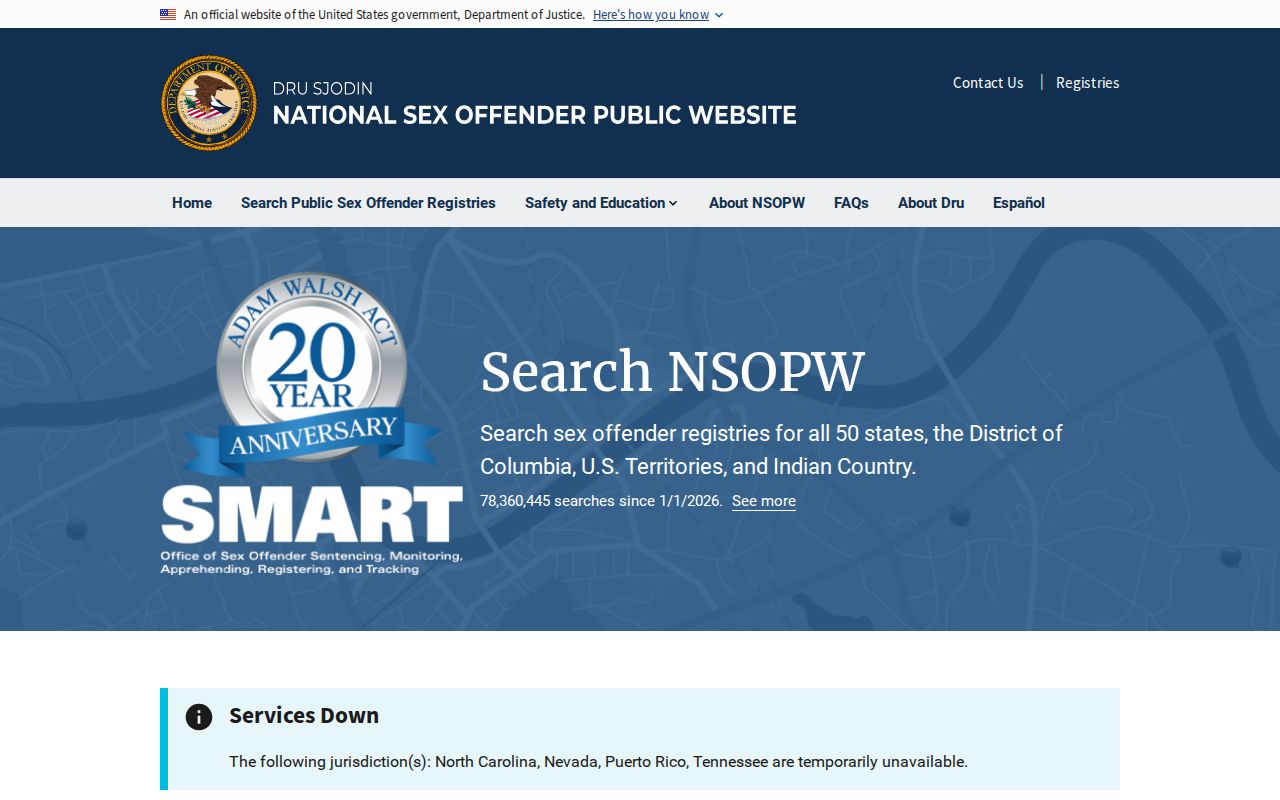
A national no-match does not override Alabama publication rules, local verification work, or legally restricted records held outside public view under current Alabama law.
Inside a Registry Profile
Ala. Code §15-20A-8 defines core public registry information. No private profile was retained during research because the live interface blocked access. This inventory follows the statute, not an unofficial mirror or an assumed screen. ALEA collects more internal details, but internal collection does not mean those fields appear publicly.
The official registry-field statute shows the legal basis for public profile fields.
This distinction prevents sensitive internal identifiers from being wrongly described as public Cullman County registry data.
| Name & Aliases | Includes aliases, nicknames, and ethnic or tribal names required by law. |
|---|---|
| Photo & Physical Description | Shows a current photograph and identifying physical description. |
| Registered Addresses | Lists residence, school, and employer addresses, including transient work data where covered. |
| Vehicles | May list plates and descriptions of land vehicles, aircraft, or watercraft. |
| Covered Offense History | Provides criminal history for each covered sex offense. |
| Registration Status | States adult or juvenile category plus compliant, noncompliant, or absconded status. |
Date of birth, Social Security number, SID and FBI numbers, fingerprints, DNA indicators, household-minor details, and medical information may be collected internally. Do not assume they are displayed.
Public and internal fields serve different legal purposes. The profile can show a residence, school, employer, vehicle data, photograph, physical description, covered offense history, and compliance status. Internal identifiers help law enforcement maintain identity and reporting links. They are not a reason to infer that a public Cullman County profile will reveal every datum gathered during registration.
Missing Cullman Registry Entries
A conviction may be absent from the public registry for a lawful reason. ALEA publishes offenses covered by §15-20A-5, not every sex-related case label. A first conviction for indecent exposure or sexual misconduct is not posted. Juvenile and Youthful Offender exceptions apply, and some out-of-state, federal, military, or tribal matters require due process before posting.
Posting generally begins upon conviction and release to probation or at the end of a sentence. A no-match should not be treated as proof that no protected or nonpublic history exists. Check exact spelling and geographic filters, then use the proper court record to understand a specific case outcome.
ALEA also notes that juvenile adjudications and Youthful Offender matters follow special public-listing rules. Out-of-state, federal, military, or tribal convictions may await the process Alabama law requires before publication. These limits explain a missing public entry; they do not convert the registry into a full criminal-history service.
Alabama Registration Levels and Requirements
Alabama does not use a universal public Tier I, II, and III label for every adult. Covered adults generally register for life and verify in person during their birth month and every three months afterward. Juvenile rules vary by age, offense category, risk finding, and time since release. Read the state categories on their own terms.
| Alabama Category | Duration/Public Rule | Verification or Relief |
|---|---|---|
| Adult covered offender | Generally lifetime and publicly listed | In person in birth month and every three months afterward |
| Juvenile age 14+ for enumerated most-serious offenses | Lifetime; notice depends on juvenile risk and court rules | Possible petition after 25 years from release |
| Other covered juvenile | Ten years; generally not public unless assessed High Risk | Follows juvenile registration requirements |
| Juvenile lifetime relief | Petition possible after 25 years | Clear-and-convincing findings required |
The adult verification statute supplies the quarterly schedule.
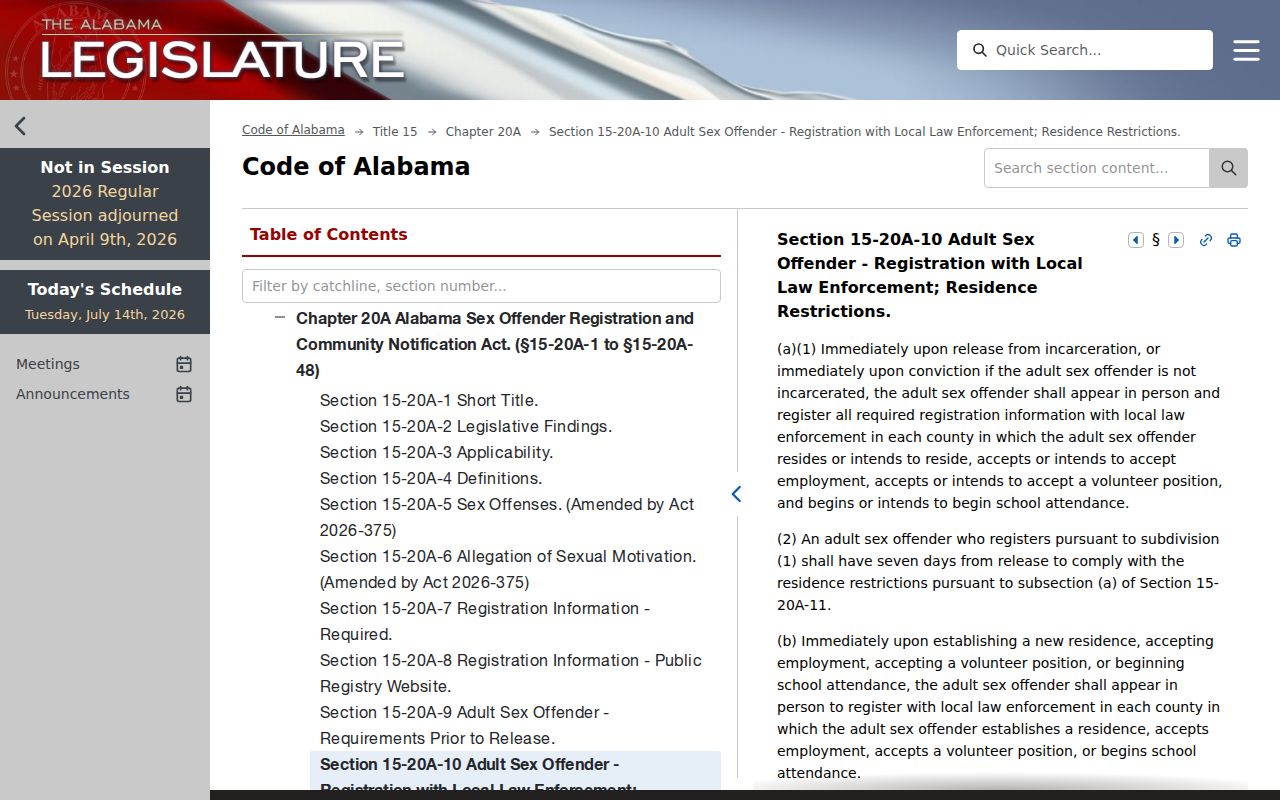
Act 2026-375 includes changes flagged for October 1, 2026, so §15-20A-5 should be checked again after that date.
Cullman Registry Residence Rule
Ala. Code §15-20A-11 generally bars an adult registrant's residence within 2,000 feet, measured property line to property line, of a school, childcare facility, qualifying resident camp, or a former victim or immediate family member. Exceptions exist, and local written preapproval applies. A map result alone is not a ruling on compliance.
Jurisdiction matters for a Cullman County address. City police may handle verification inside their limits, while the Sheriff handles the unincorporated county. Submit an address question to the proper agency and allow officers to apply the statute and any exception.
Cullman County Notification Zones
Community notice changes by local population and jurisdiction. In a qualifying city of at least 5,000 residents, police notify residences within 1,500 feet and schools or childcare facilities within three miles. In smaller municipalities and unincorporated Cullman County, the Sheriff notifies residences within 2,000 feet and schools or childcare facilities within three miles.
The split means one Cullman County search result can trigger different local notice distances based on the address. Confirm whether it lies inside Cullman city, another municipality, or the unincorporated county before assuming which office sends notice.
Community Notification and Lawful Use
The Cullman County sex offender registry supports community awareness, family safety planning, and official notice. It does not state that ALEA has made an individual prediction of each listed person's present dangerousness. Confirm an address through the official registry, use alert tools when available, and report suspected noncompliance to law enforcement rather than acting on it personally.
Misuse warning: Under Ala. Code §15-20A-8, registry information may not be used to unlawfully injure, harass, or commit a crime against a listed person or anyone at a reported address. Civil or criminal penalties may apply.
Use the local agency for address verification and the ALEA Registry Unit for statewide system issues. Call 911 only for an immediate threat or emergency.